MATTHEW BRIGHT
  • Home
  • Writer
    • Short Fiction
    • Between The Lines
    • Stories To Sing In The Dark
    • Between The Lines
  • Editor
    • The Myriad Carnival
    • Threesome
    • Clockwork Cairo
    • Gents
  • Design
    • Inkspiral Design
    • 20 Minute Design Challenge
  • MIsc.
    • 20 Minute Design Challenge
    • Essays >
      • 'Participation'
    • Reviews
    • Advent Calendar 16: Short Story Re-Reads
    • Advent Calendar 15: Novel Re-Reads
  • Contact

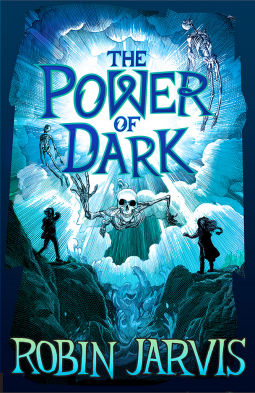
THE POWER OF DARK / ROBIN JARVIS

6/15/2017

1 Comment

 
Picture
Encapsulate the book in one sentence?
Ancient evil is rising from the deep to threaten the seaside town of Whitby, and Verne and Lil are all that stand in its way.

Intriguing, tell me more.

In Whitby, two warring forces of dark magic will pit East Cliff against West Cliff, dredging up secrets and betrayals from the path, and threatening the lives of teenagers Verne and Lil, and the brightly-coloured oddball witch Cherry Cerise.

Why this, why now?

I am a fan of Robin Jarvis’ writing — he does timeless children’s fiction with more than a large helping of genuinely creepy darkness to it. I’m a particular fan of his series The Whitby Witches, partly because I think they are excellent books, and partly because the town of Whitby is my favourite place on the planet; his first trilogy did a great job of conjuring the atmosphere of the town.

For those not in the know: Whitby is a small fishing town on the edge of the North York Moors, split on either side of the harbour, with the West Cliff home to Captain Cooks whalebone arch and the royal crescent of grand hotels, and the East Cliff home to Whitby Abbey, at the top of its famous one-hundred-and-ninety-nine steps. If you’ve heard of Whitby, you’ve probably heard of it from Dracula. I adore Whitby (seriously: I have plans to retire there, and I curate The Whitby Bookshelf on facebook.)

So if that gives you an idea of how excited I was when it was announced Robin Jarvis would return to writing about Whitby for a new series, imagine how I was when I came across the ARC on netgalley and discovered I was already pre-approved by the publisher.

What genre would you say it is?

The Power of Dark has the feeling of classic children’s fiction, somewhere between horror and adventure, with strange creatures hidden in the shadows and ancient evils lurking in history. This particular volume has a more contemporary feel to it than I’m used to, partly because of the mobile phones and video chats and the like, and partly because it reflects Whitby as it is now (a tourist destination, full of gothic shops that cash in on the enormous influx of people at Whitby Goth Festival; it’s accurate enough that the book even boils itself down to a stand-off between goths and steampunks which, if you’re familiar with goth weekend, is a hilarious injoke.)

Did you finish it? Did it work for you?

I loved it.

I loved it, but with all apologies, because really the reasons I loved the book are quite personal, and if you’re reading this to get an objective review then this won’t be much use to you. I loved it because this book felt like it had been written for me.

Not in a universal or general way, but in a terrifyingly specific way. Let’s start with the characters of Verne and Lil. Verne is the awkward boy who starts the story being bullied by a bunch of older girls. His best friend, Lil, is an artsy misfit whose parents are arch-goths. Her family surname is the Wilsons. Now, let me give a quick summary of my adolescence: an awkward boy (who was picked on by everyone but yes, on occasion, girls). My best friend was an artsy misfit whose parents were arch-goths (their house was painted inside to resemble a castle. My parents didn’t allow Halloween, and the only one I ever attended was at theirs.) Their family surname was the Wilsons. (Plus, just like me, Lil has an obsession with old and forgotten words… I mean, come on. Witchcraft is afoot.)

Pile all that on top of the perfectly-evoked Whitby setting, the sheer enjoyment factor that always comes with Jarvis’ prose, and the nicely-balanced mix of spooky mystery and childish escapism, and the confection as just right. I could not have asked for a book better tailored to me.

If I’m trying to be objective, though, this is still a great book. The opening quarter is spectacular, as a storm rips through Whitby, exhuming skeletons from the graveyard and scattering them over the rooftops below. Although the book relies on the separation of Verne and Lil from about a quarter of the way in, their friendship feels real and genuine, and Cherry Cerise is a scene-stealer that I look forward to more of in the future. There’s also a few things in the mix that stand out from the usual supernatural-mystery atmosphere, including a diverting switch-up in tone when half the town becomes masters of clockwork and machinery overnight, like a rather macabre Professor Branestawn adventure. And the ending segues nicely into what I assume will be a further two books in the series.

My only niggle is, finishing the book, I was left with a faint feeling that Goths were the butt of the joke in the book. (The raised army of evil paint themselves up as Goths; there are swipes at ‘adults living out teenage fantasies’; the heroine’s triumph is sabotaging Goth weekend with brightly-coloured knitting.) I suspect I’m being overly sensitive; after all, Goths are the first to mock themselves, and would no doubt appreciate being fictionally resurrected as an army of evil…

Give me a good quote:

(Not the most representative, but so evocative of my own childhood I couldn’t possibly pick any other:)
The boy cast his eyes round the Wilsons’ eccentric orange-and-black kitchen. It was a weird combination of Macbeth and IKEA, just what you’d expect from a couple of modern-day witches. He loved coming here. It was the complete opposite of his own home above the amusement arcade where his dust-phobic mother vacuumed the carpets and curtains daily and nothing was ever out of place.
    Lil’s parents were well known locally, being the owner of an occult shop in Church Street called Whitby Gothic, selling all manner of peculiar and supposedly magical things. They loved dressing the part too, mainly in black with a strong Victorian twist, which they had also foisted on Lil from the day she was born.

Is it available today?

Out now, from Egmont.

​Soundtrack of choice: 

I’m going with Run Boy Run by Woodkid
1 Comment

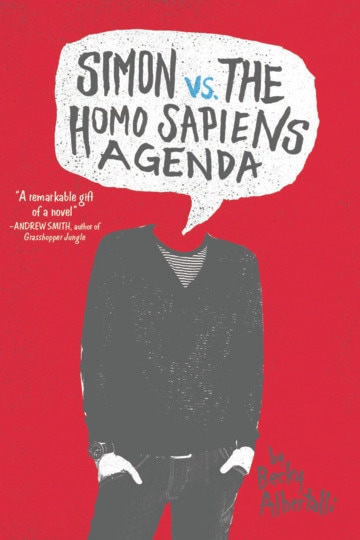
SIMON VS THE HOMO SAPIENS AGENDA / BECKY ALBERTALLI

6/15/2017

1 Comment

 
Picture
Encapsulate the book in one sentence?
Simon’s gay and that’s a sort-of-a-problem-but-not-that-big-a-problem-but-he’s-a-teenager-so-everythings-kinda-tough.

Intriguing, tell me more.
Okay, so that summary’s a bit snarky. Simon is gay, and quite possibly in love with Blue, someone he only knows anonymously from the other end of an email. And now some kid called Martin has got hold of those emails, and is blackmailing him into helping Martin hook up with Simon’s friend Abby… and thus the complications ensue.

Personal Choice, Book-Pot, Re-read…?
This one’s been on my radar for ages, first for online blogosphere buzz, then because I kept seeing it in bookshops everywhere, and then for an announcement that a movie was in the works. I pay attention to books with queer protagonists, and I can’t believe it’s taken me so long to get around to reading one that’s had such mainstream success. (That said, much buzz and expectation can lead to a lacklustre reading experience, coughqueenofthenightcough, so maybe leaving it this long was wise…)

What genre would you say it is?
It’s a YA novel. It’s a very YA novel, by which I mean it’s pretty much the epitome of the style and mode of this generations brand of very successful YA novels. (We’re looking at you, John Green.) That’s not a criticism; not every novel has to reinvent the wheel, and Simon Vs does the wheel really well (plus, it’s got the distinguishing factor that this is a gay novel, which isn’t uncommon in YA, but it’s nice to see a chart-conquering book that isn’t a male-female romance.) The cover compares it to the lovechild of Rainbow Rowell and John Green, which is indicative but not entirely spot on, in my opinion. In fact, what it reminded me the most of was early David Levithan.

Did you finish it? Did it work for you?
I read it pretty much in one go, over one night, and I thoroughly enjoyed it. It’s sweet, its funny in the right places, it’s evocative in the right places, and it does a great job of encapsulating contemporary youth culture without being cringily awkward or patronising. (That can’t be overestimated by the way; sure, in ten years the tumblr and facebook stuff in there might date the book badly, but right now it’s spot on.) It was refreshing to have the tension of the book deflected away from any particular stress over coming out (Simon isn’t overly bothered about his blackmailer outing him, and knows his family will, on balance, be accepting) but is instead concerned over the forced outing of Blue instead. It’s an elegant undercut to the melodrama one usually expects from this kind of story. Plus, the rest of the cast of friends and enemies are entertaining, well-drawn and mostly three-dimensional, another pitfall hurdled.

So in essence, the book does everything it sets out to do really well, with a cute, appealing take on a gay protagonist. My only criticism is that the theoretically-mysterious identity of Blue is so bleedin’ obvious that it slightly undercuts the TA-DA! ending. But I’m quibbling now.

Give me a good quote:
(Okay, so there’s probably more representative quotes, but I bookmarked this one when I was reading, so I’m going with it.)
You can’t imagine how much I hated middle school. Remember the way people would look at you blankly and says, “Um, okaaaaaaay,” after you finished talking? Everyone just had to make it so clear that, whatever you were thinking or feeling, you were totally alone. The worst part, of course, was that I did the same thing to other people.

Bad reviews? What do you mean, bad reviews?
(I like to read bad reviews of books I like. Everyone’s entitled to their opinions and this section isn’t meant as mean-spirited, but as an author it’s bad form to respond to your own reviewers. No-one said anything about other people’s. And with all apologies: this one tackles a really petty quibble, and a fairly major one.)
  • “The youth culture stuff is disrespectful / pathetic / hilarious / delete as applicable. It’s not ‘the Tumblr’!” I’m guilty of this, because when I read it I wanted to snark at the use of ‘the’ in front of Tumblr. Oh, you foolish adult, I thought, thinking you are in the loop and up to date. But this is basically the only reference with a ‘the’ and I think it’s actually meant to be referring to the tumblr page (specific not universal) which is featured in the plot. A slip in editing that comes out sounding adult-down-with-the-teenspeak. I think the book did a decent job with youth culture. But then what do I know? I’m in my twenties, and apparently I call it ‘youth culture’ now.
  • “It is very clear that this book was not written for the queer community. It was written for straight people. It is hard to say why but if you aren’t straight, you can tell its not for you, but for the majority.”
         Okay, I won’t be flippant about this one. I actually sort of take the point–there is something of that feeling when you read this. I don’t think this was because the writer targeted a mainstream (read: straight) audience; I’m more inclined to suggest that it was the universality of the story that enables its mainstream success. Which is a subtly different thing.
         I think the feeling arises from the fact that Simon never struggles with the idea that he is gay; this might be a coming-out story, superficially, but it’s not a coming-to-terms story. Any difficulties he might have had realising he was gay are never shown or discussed. In fact, it’s what I quite liked in principal: avoiding another tedious hand-wringing coming out story. Queer lit and YA has moved past the need for every story to be that. And it is certainly a good thing that a bestselling YA novel can feature a gay protagonist who exhibits little-to-no concern that he is gay.
         But here’s the catch: when you’ve grown up queer, that struggle is more than likely an integral part of your adolescence.The success of Simon Vs is that Simon’s story manages to feel universal, and so while it’s great that a gay protagonist can now be just as much a lead, with just as many adolescent insignificant-but-therefore-completely-huge problems as any other protagonist, the catch-22 is that there’s this lack of specificity that for some queer readers is a problem. When we read a story look like this, we’re looking for identification. That kind of recognition is hard to come by in books and media, and so it’s precious when we find it, and there wasn’t much of that reflected back at me in Simon Vs because this is not the story of me, or probably anyone from my generation. And that’s fine. We don’t have to love this book like a book written only for us; we can love this book as a book written for everyone.

Is it available today?
‘Tis indeed. It’s bloody everywhere.

​Soundtrack of choice: 
It should be Between The Bars by Elliott Smith, but I’m actually going with my favourite Elliott Smith song, Let’s Get Lost. Also, have some Sufjan Stevens too.
1 Comment

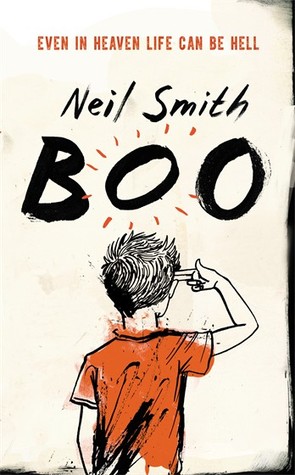
boo / neil smith

6/15/2017

4 Comments

 
Picture
Encapsulate the book in one sentence?
Curious Incident meets A Matter of Life and Death.

Intriguing, tell me more.

Oliver Dalrymple, a somewhere-on-the-spectrum teenager recently deceased, arrives in an odd afterlife where he is left to decode the confusing mysteries of both human interaction, and his own demise.

Personal Choice, Book-Pot, Re-read…?

Years ago, on a trip to London in my late teenage years, I discovered two books in Foyles: Postsecret and Bang Crunch by Neil Smith. I read both in the gardens of Buckingham Palace, in bright sunshine. I adored both books. To this day, I read Postsecret every weekend; it was only when I saw Boo on the shelves of my local indie bookshop (who I have a sneaking suspicion only stock attractively-covered hardbacks) I was shocked to realise how bloody long it has taken a follow-up to Bang Crunch to arrive. I bought it immediately.

What genre would you say it is?

It’s a coming-of-age novel, told through a fantastical filter which is basically my favourite type of novel. This isn’t a book that’s overly preoccupied with the mechanics of the metaphysical; although the world of Boo’s afterlife is clearly delineated, it’s construction is used for pathos rather than supernatural adventure. At its heart it’s about a boy learning to negotiate the complicated pathways of his adolescence, and come to terms with trauma.

Did you finish it? Did it work for you?

I did and it did! For the first twenty-five pages or so I was worried; Boo begins as such a disassociated, analytical voice and the opening of the story concerns the establishing of a world, and so for that first handful of pages I found it hard to engage. And then Johnny joins the novel, Boo’s volatile classmate who is obsessed with finding ‘Gunboy’, the youth they believe shot them, and the book takes off, weaving a delicate story that is blackly funny, packing both emotional heft and two (!) surprising turns that I didn’t see coming before pulling everything expertly to a hopeful, perfect ending.

Give me a good quote:

From my favourite scene, in which some of the ‘gommers’ (those who were murdered) act out their deaths at a gathering:
"For once in my short little life, I wasn’t fat enough,” Thelma says, slipping the noose around her neck. “The branch held.”
Then the lights go out completely. We hear footsteps as the actors move offstage. Beside me, Esther whispers, “Is it over? Can I open my eyes.”
But it is not over. A voice onstage starts singing. It is Thelma. She is still there.
The song she chose is on of your favourites, Mother and Father. It is a Billie Holiday song about bulging eyes, twisted mouths, and the blood on leaves. It is a song about hanging from a poplar tree.

Bad reviews? What do you mean, bad reviews?

(I like to read bad reviews of books I like. Everyone’s entitled to their opinions and this section isn’t meant as mean-spirited, but as an author it’s bad form to respond to your own reviewers. No-one said anything about other people’s.)
  • “Too much language..even if they put an * in the middle of the word, its still profanity. I know what they’re saying.” Must have a hard time out there in the world! Plus I suspect the stars are intended as part of the character’s voice, rather than an actual desire to protect it’s fragile readers from the (very infrequent) swearing.
  • “Can we please have a moratorium on autism-spectrum characters, especially kids?” Indeed, literature is overflowing with them.
  • “This book was not at all what I was expecting it to be.” That is not a reason for a bad review. Stop it. Review the book you read, not the book it turned out not to be.
  • “In the audiobook version, they spell out all of the swear words. This made my skin crawl.” That does sound awful, actually.

Is it available today?

‘Tis indeed.

​Soundtrack of choice: 

Waltz 1 by Elliott Smith.
4 Comments

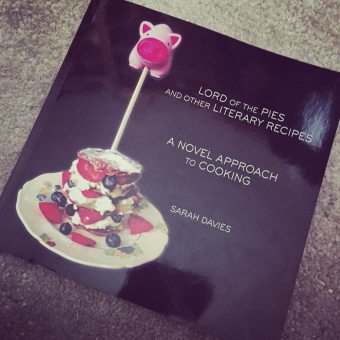
lord of the pies / sarah davies

6/15/2017

2 Comments

 
Picture
Encapsulate the book in one sentence?
Pun-tastic literary recipes.

Intriguing, tell me more.

Well, I mean, that does mostly cover it. A selection of literary-themed recipes, titled with some genius punny titles.

Personal Choice, Book-Pot, Re-read…?

I made my yearly pilgrimage to DeMontfort University’s States of Independence festival, and I always make a point of going to see the current students do their readings from the Publication Project. (The Publication Project is the third year assignment in which students produce a printed book, with the intention being to write for the purpose of publication. It was the origin of mine and Chris Black’s Between The Lines, an experimental novella which will see proper publication sometime shortly!) It’s always nice to see what the new students are doing, and for some reason I relish the sweaty-palm flashbacks to having to do our first nerve-wracking readings as students [number redacted] years ago.

The publications are generally short story or poetry collections, but this year there was a left-field entry that made me dribble into my own hand with laughter (thankfully unseen on the back row) so I promptly bought a couple of copies. The author was handing out free cup-cakes too, which was in no way a contributing factor to my review, but does mean I can confirm the quality of the recipes (if the cup-cakes are anything to go by, anyway.)

What genre would you say it is?

This is quirky niche-gift fodder. Basically, it’s the food version of Tequila Mockingbird. This belongs on the shelves of Waterstones just before Christmas. The puns are hilarious, but the recipes do look equally good (which is actually pretty impressive, because usually the joke is at the expense of the actual content.)

Did you finish it? Did it work for you?

Oh, man, it’s brilliant. Every title is hilarious, and the food looks great. It’s incredibly funny and endearing, and I’m a bit in love with the book. And it’s gotta be said that for what is a student project the production value is on point. This looks like a professional product (which I can attest as someone who know works doing that sort of thing, but once had to put together a publication project like this with the knowledge and resources I had then, that is hard to do.) Serious credit due.

Give me a good quote:

My top five favourite pun-titles:
  • Prawn Free
  • Chitty Chicken Rendang
  • Lady Chatterley’s Liver
  • The Handmaid’s Kale
  • Sons and Pavlovas

Is it available today?

Um, well, no, probably not. I think the DMU guys print about ten copies so I’ve probably got about 20% of the stock on my desk. But it should be printed! Someone get on that!

Soundtrack of choice: 

Tequila  Mockingbird by Ramsey Lewis. (Although actually I was going to pick Sweet Cold Colation by Professor Elemental because it has lots of cake jokes, but it’s also a bit filthy so I’ll let you search it if you want to, rather than link!)
2 Comments

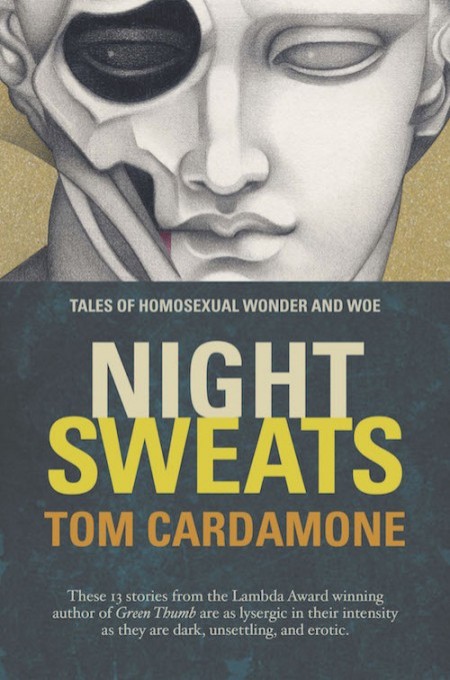
NIGHT SWEATS / TOM CARDAMONE

6/15/2017

3 Comments

 
Picture
Encapsulate the book in one sentence?
I’ll let the book cover do it: Tales of Homosexual Wonder and Woe.

Intriguing, tell me more.

Tom Cardamone’s second collection of short fiction — gay speculative fiction with dark, weird undertones.

Personal Choice, Book-Pot, Re-read…?

Not only personal choice but a pre-order (and only about five books a year earn such a thing.) You may or may not recall my review of Cardamone’s first collection, Pumpkin Teeth, some time ago, in which I gushed effusively. I’ve been looking forward to another collection ever since.

What genre would you say it is?

Cardamone’s stories are actually quite hard to categorise. The most obvious label for his stories is queer, but I mean that as far more than simply a comment on the sexuality of his characters. Cardamone’s brand of queer runs bone-deep to the unnervingly off-kilter, shady edges of a world that tips vertiginous on a queasy knife-edge of weird.

Did you finish it? Did it work for you?

For me, Night Sweats doesn’t supplant Pumpkin Teeth, which I count as a pretty much unassailable work of brilliance, but it a great collection that I whole-heartedly recommend. My highlights were:
  • The Ice King does queer-supervillain brilliantly, with a whole bunch of world-building that makes me want to see Cardamone carry on expanding this as a series. Mama Bear, an arch-villainess who tucks the other supervillains under her wing, and morphs into a male bear and fucks the Ice King, is just basically fuckin’ awesome, and the ending is just the right side of sweet. (Sweet–betcha didn’t think I’d be using that word to describe a Cardamone story, did ya?) The story that follows it, Kid Cyclops, is just as good, occurring within the same world but telling the story of a generation of mutant giant children. It’s darker than Ice King, and would make a kick-ass novel.
  • Mutinous Chocolate is erotica done the Cardamone way, which is to say it’s sensuous, nihilistically fucked-up, and gorgeously written. Magic-infused chocolates introduce the recently-broken-up protagonist to a series of sexual delights beyond his imagination with a string of mythically-transfigured lovers. This is how erotica should always be, by the way: evocative, rich and entirely lacking in rubbish euphemisms for genitalia.
  • Opening story Owl Aerie, which is a sort of domestic-gothic, magic-realist tale of a town upon which owls confer luck and status. This showcases Cardamone’s excellent ability to weave speculative fiction into a queer coming-of-age narrative, though the reason I’ve listed this third despite being the first is that despite it’s excellence it also exemplifies something I found myself feeling about several other of the stories in this book: it should be longer. As a self-contained short story Owl Aerie is great, but it also feels like the start of a brilliant novella like Green Thumb, and the same is true of stories MS Found In A Bookstore and (as I already mentioned) Kid Cyclops. (I don’t necessarily mean this as a criticism, and if I did, saying ‘I wish this went on for longer’ is probably not the worst one in the world to receive.)

Give me a good quote:

“Though the attic was a world unto itself, a place without order of rules, I was no angelic gatekeeper, but as lost and as mystified as the customers. Here time stopped and treasure floated to the surface among a sea of books, boxes of books, rickety gray splintered shelves poured forth a waterfall of volumes, manuscripts, letters–and the customers, mouths agape, not knowing what to do with their hands so fingers hung in the air, vibrating like humming bird wings until they could gather the courage to alight on the flower that blossomed within their heart: the hand-scrawled manuscript of the last book of an incomplete trilogy, the author dead of cirrhosis. The coveted children’s book, title long forgotten, opened to the very page that set their dreams afire. Signed editions long sought, privately published ancestral memoirs, always what the customer was looking for. Always.”

Is it available today?

Out now from the excellent Bold Strokes Books.

Soundtrack of choice: 

Perfume Genius – Queen.
3 Comments
<<Previous
Forward>>

    Archives

    July 2018
    May 2018
    April 2018
    June 2017

    RSS Feed

Proudly powered by Weebly
  • Home
  • Writer
    • Short Fiction
    • Between The Lines
    • Stories To Sing In The Dark
    • Between The Lines
  • Editor
    • The Myriad Carnival
    • Threesome
    • Clockwork Cairo
    • Gents
  • Design
    • Inkspiral Design
    • 20 Minute Design Challenge
  • MIsc.
    • 20 Minute Design Challenge
    • Essays >
      • 'Participation'
    • Reviews
    • Advent Calendar 16: Short Story Re-Reads
    • Advent Calendar 15: Novel Re-Reads
  • Contact